
You probably think you would notice if your dog or cat was carrying too much weight. Most owners do, until the vet puts them on the scales and the number tells a different story. The slow creep of extra grams, hidden under a thick coat or dismissed as “just his breed,” has made overweight pets the new normal in waiting rooms across Johannesburg, Cape Town, and Durban. Social media does not help. A Pomeranian shaped like a loaf of bread racks up thousands of likes, and suddenly that silhouette feels familiar rather than alarming. You see your pet every day, so the change is invisible because it happened yesterday, and the day before, and last month.
Your hands matter more than your eyes. Body condition scoring, the method vets use to assess fat reserves without relying on breed weight charts, helps you cut through the noise. It works for a Boerboel and a Yorkie, for a street cat and a Persian, because it measures what you can feel rather than what the scale claims.
How to Feel What Your Eyes Cannot See
Start with the ribs. Run your palms along your pet’s sides with gentle, flat pressure. On a healthy animal, you should find each rib easily, like tracing the back of your own knuckles when your hand is relaxed. If you are pressing through padding or cannot count them at all, the fat cover is too thick. If every rib juts out sharply and visibly, your pet is underweight. The ideal sits in between: palpable, not prominent.
Move to the waist. Stand above your dog or cat and look down. A healthy body narrows behind the ribcage, creating a visible hourglass. From the side, the abdomen should tuck upward toward the hind legs, not hang in a straight line or sag downward. Overweight pets lose both landmarks. The waist disappears into a barrel shape, and the belly develops a low swing or a fat pad between the thighs.
These three checks—ribs, waist, and abdominal tuck—form the core of any body condition score. Vets typically use a 5-point or 9-point scale, with the middle numbers marking ideal condition. The exact number matters less than consistency. What score did you get this month? Is it the same as last month, or creeping upward?
When the Scores Slip
A single high reading is not a crisis, but it signals a problem. Book a vet appointment before you change anything. Sudden calorie cuts or unsupervised exercise can harm an animal with underlying conditions. Weight gain in pets sometimes traces to hypothyroidism, Cushing’s disease, or other metabolic issues that diet alone cannot fix. Your vet will run bloodwork, set a target score, and calculate precise daily calories rather than guessing with “light” kibble.
The professional plan will likely include a prescription or therapeutic weight-loss diet, measured in grams, not scoops. It will account for treats, often swapping commercial biscuits for green beans or carrot chunks. It will build exercise gradually around your pet’s joints and fitness level. Expect follow-up weigh-ins, probably monthly at first, to adjust the plan before frustration sets in.
Tracking Month by Month
Once you have a baseline score and a vet-approved target, consistency becomes your only job. Reassess your pet’s body condition on the same date each month, using the same scale, ideally by the same person. Palpate the same three areas. Has the rib cover thinned? Can you see more waist from above?
Photographs help where memory fails. Take a top-down shot, a side profile, and a front-facing image against a plain wall, with the same lighting and standing position each time. Compare them side by side after three months. The difference your daily hands missed will show up in the frame.
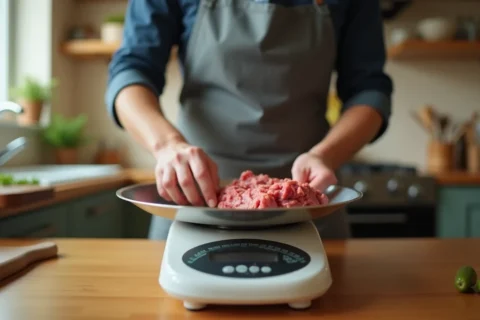
Feeding precision matters just as much. Buy a digital kitchen scale and weigh every portion in grams, including treats. “About half a cup” is how owners lose the battle. Record the numbers in a notebook or phone note, alongside daily exercise—a twenty-minute walk, a swim at the local dam, a slower-than-usual climb up the stairs. Small logs reveal patterns. Maybe the weight stalls every July, when the evening walks shorten. Maybe it drops faster when you split meals into three feedings instead of two.
Your pet’s healthy shape is not a number on a breed chart or a comment under an Instagram post. It is a set of physical landmarks you can learn to read with your fingertips, tracked with the patience to notice change before it becomes a crisis. The work is dull, methodical, and entirely worth it.